Planning & Analysis · Emergency Response Games

Pompeii Emergency — Game-Based Peer Evaluation of a Municipal Plan

Four studies, one tabletop exercise: compare solutions and decisions for a municipal civil protection plan.

Explore the documents

Explore the project and its context through these documents.

Cover of Emergenza Pompei - The methodological corpus

PDF · IT · 49 pages

Emergenza Pompei - The methodological corpus

Adriano Pantaleo. From comparative analysis to the tabletop exercise: one volume making the method, observation tools and limits of the exercise explicit.

Edition 1.0, 27 October 2026. Italian text. Preview: cover, authorship, contents and exercise sequence.

Full document available on request.
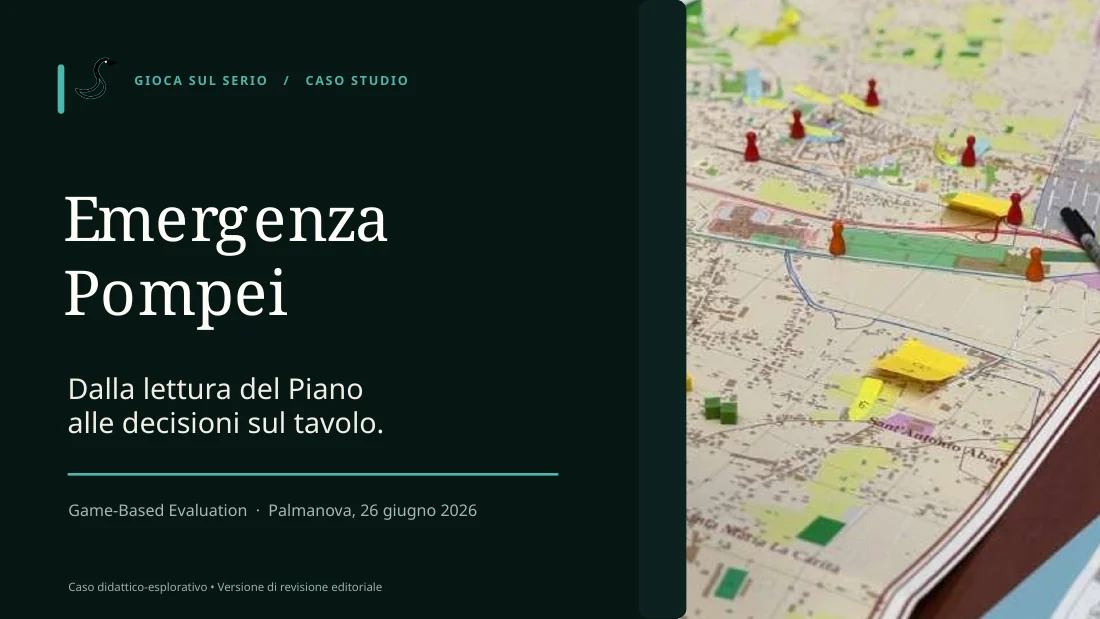
Emergenza Pompei presentation cover with a photograph of the game map
Emergenza Pompei · Adriano Pantaleo, 2026.

What it is for

Compare four teams’ solutions and observe how they are applied to the municipal civil protection plan through scenarios, map-based decisions and peer evaluation.

My contribution

Method Designer, Lecturer, Exercise Designer and Lead Facilitator. 16 total teaching hours in wargaming theory, design and conduct, including the exercise designed and facilitated in Palmanova on 26 June 2026. Four groups; scientific and methodological thesis support and co-supervision of one thesis. Author of the methodological chapters collected in the 49-page corpus, including comparative coding and exercise design.

40participants
4groups
16hours
4studies

How it works

Four independent studies inform 24 hypothesised problems, 16 events that reveal issues and 30 solutions. The event → latent problem → trigger → penalty chain connects a map-based sandbox, negotiation and consequences.

Results and materials

Four studies compared and one exercise completed. The available observation forms document six of the twelve team comparisons.

Blind spots under review

Candidate industrial accident

A known technological risk that is peripheral to dominant local planning scenarios; verify interdependencies with alerting, roads, evacuation, tourism and external plans.

Gate G9 management

Possible hidden dependency or single point of failure in the Municipality → gate → Port of Salerno → embarkation-system chain.

Coming next

Complete the collection and review of observation forms, reconcile penalties and examine similarities and differences between solutions.

Full method on request

The corpus by Adriano Pantaleo brings together comparative analysis, exercise design, working templates, results, limitations and appendices. The complete 49-page document is available on request; the preview contains four selected pages.

Opens a pre-filled email to info@giocasulserio.it.

CASE STUDY · GAME-BASED EVALUATION · PALMANOVA, 26 JUNE 2026

From the plan to the decision

We turned four independent analyses of Pompeii's municipal civil protection plan into a peer-based decision exercise. The purpose was to observe what happens when a problem moves from a written document onto the game table.

The scenarioPompeii

A real municipal setting · earthquake, volcanic, flood and industrial hazards · residents and visitors

Emergenza Pompei presentation cover with a photograph of the game map
View the presentation

Comparison with slide 15 of the presentation. The remainder of 71 shown on that slide comes from subtracting counts covering different sets of comparisons. Source for the updated comparison: methodological corpus, edition 1.0, p. 48. The same six comparisons total 101 points in the corpus and 109 in the presentation: an eight-point discrepancy across three comparisons. The overall 180-point total covers twelve comparisons. Reconciliation requires the completed observation forms and any agreed corrections.

18 slides, opening on Google Drive in a new tab.

Inside the methodological corpus

Four selected pages from the 49-page corpus by Adriano Pantaleo. The document is in Italian. Open each page to explore the preview; request the complete method by email.

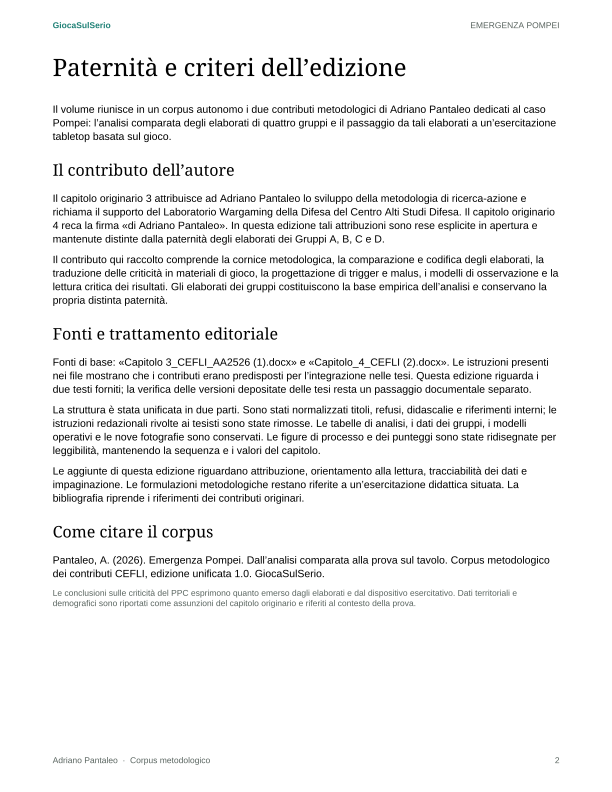
Cover page 1

Title, author and scope of the methodological corpus.

Cover - page 1 of the Emergenza Pompei corpus

Open this page at full size - new tab

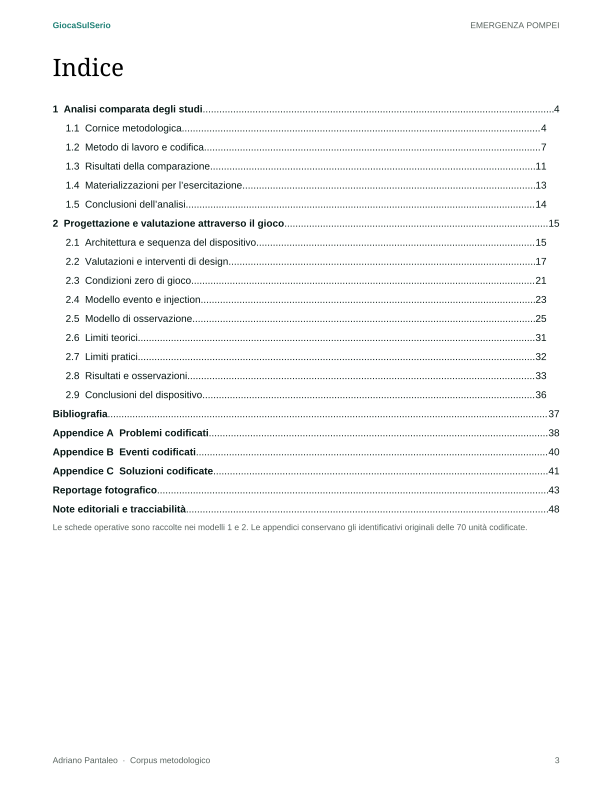
Authorship and editorial criteria page 2

Adriano Pantaleo’s contribution, authorship of the group studies and source documents.

Authorship and editorial criteria - page 2 of the Emergenza Pompei corpus

Open this page at full size - new tab

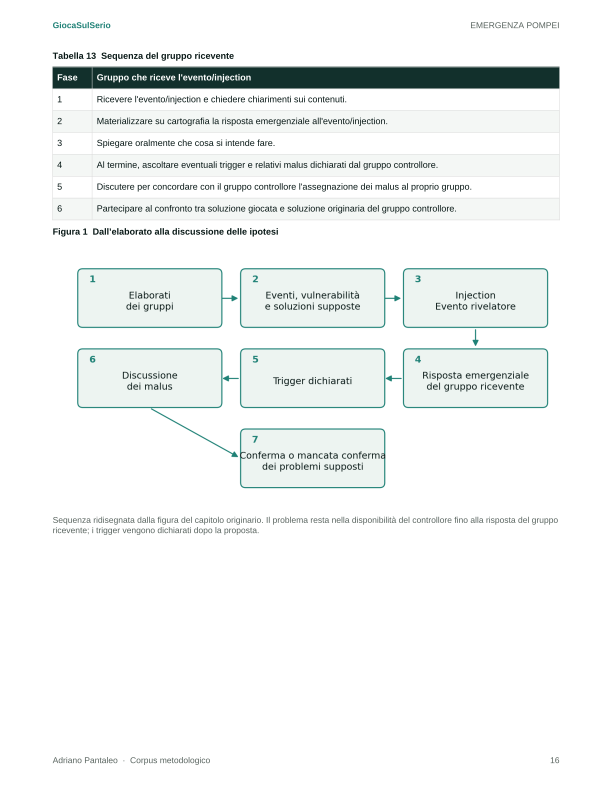
Contents of the complete volume page 3

The two parts, working templates, appendices, bibliography and editorial notes.

Contents of the complete volume - page 3 of the Emergenza Pompei corpus

Open this page at full size - new tab

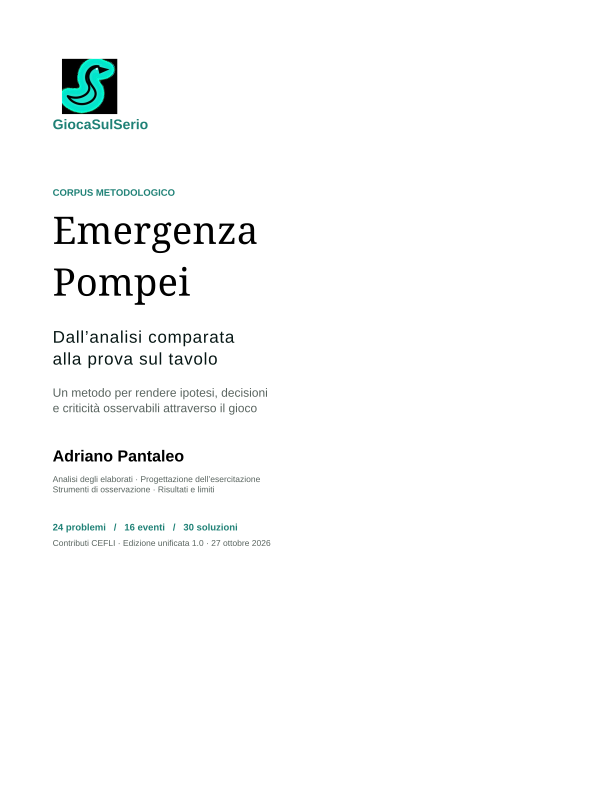
The exercise sequence page 16

The receiving team’s actions and the sequence from written studies to discussion of hypotheses.

The exercise sequence - page 16 of the Emergenza Pompei corpus

Open this page at full size - new tab

How the work became playable

01

Four dossiers

Teams A–D independently identified candidate problems, possible solutions and revealing events.

02

A situation to manage

The controller presents an event while keeping the problem card hidden. The receiving team works with partial information.

03

Decisions on the map

Command centre, shelters, streets, residents and responders need concrete locations and an operational sequence.

04

Triggers and debrief

Choices activate observable conditions and tactical, communication or structural penalties, followed by a comparison of solutions.

One decision in the exercise: where should earthquake evacuees go?

Team C's problem C1 concerns the actual availability of temporary shelter areas. All three receiving teams identified it; their responses nevertheless earned different penalties.

Team A3penalties · problem identified
Team B5penalties · problem identified
Team D0penalties · problem identified

The useful question: why can a shared diagnosis lead to different assessments? Recognising a problem, proposing a solution and placing an operational response on the map are separate observations.

Source: Team C observation forms, appendices 1–3, C1 comparison. Penalties describe the outcomes of decisions made in the game.

Convergence and divergence: what are we actually comparing?

Before play

Initial convergence

Which issues recur across independent analyses? Where do the dossiers identify different vulnerabilities?

After play

Final convergence

Do observed choices align with the solutions imagined earlier? Which omissions, alternatives and unexpected outcomes appear?

Shared issue · Convergent responseDiagnosis and operational choices align
Shared issue · Divergent responseSame diagnosis, different solutions
Isolated issue · Convergent responseA possible overlooked concern
Isolated issue · Divergent responseHypothesis needing further evidence

The matrix helps identify similarities and differences. Individual cases are being classified through coding of the observation forms.

What the decisions revealed

Shelters and safety checks

A shelter listed in a plan still needs checks for actual availability, safety and workable alternatives.

Industrial risk and schools

A school evacuation prompted the option of allowing parents to retrieve children; the debrief noted potential exposure to contaminated air.

Inter-agency coordination

Teams discussed how the municipal command centre, Prefecture and fire brigade should coordinate with external emergency planning.

6 / 12

team comparisons with accessible observation forms

109

penalty points in the six-comparison subset of the presentation

180

total penalty points across twelve comparisons in the methodological corpus

The value of comparison

The exercise revealed decisions, omissions and different responses to the same problems. These observations of in-game behaviour guide further technical review of the municipal plan.